
Shell Shock: Hong Kong’s Role in the Turtle Trade Crisis
A photo of a cute storybook-perfect turtle appears in my social media feed. With its soulful black eyes and geometric shell pattern, the creature’s innocuous appearance belies the criminal activity that underscores its journey from the streams of Mexico to an airport carousel in Hong Kong.
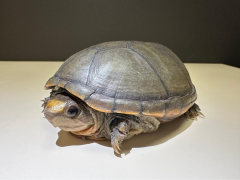
The picture, which appeared on the Facebook page of the Agriculture, Fisheries and Conservation Department (AFCD), shows one of the six Vallarta mud turtles (Kinosternon vogti) seized in 2025 at Hong Kong International Airport while being trafficked to mainland China. The species is listed as Critically Endangered on the IUCN Red List, with fewer than 1,000 left in the wild. At least one of the six turtles could be traced back to a group of 55 stolen from a Mexican university assurance colony, by men posing as government officials.
Their appearance in Hong Kong is symptomatic of a wider illegal trade problem that directly contributes to the downward spiral of freshwater turtle and tortoise populations worldwide.
Traded to Extinction
According to the IUCN-affiliated Turtle Conservation Coalition more than half of the world’s turtle and tortoise species (Testudine spp.) are threatened, or already extinct, making them the most at-risk animals amongst reptiles. Many species are in high demand across rapidly growing Asian markets. Rare turtles and tortoises are highly sought-after as exotic pets and status symbols, while turtle meat, shells, blood, and eggs are used in Traditional Chinese Medicine remedies.
In its 2025 review report, the Turtle Conservation Coalition profiled 66 of the world’s most endangered turtle and tortoise species. The Coalition has produced these assessments every few years since 2003 to highlight species at imminent and high risk of extinction with the intention of raising awareness of the turtle survival crisis, characterise the nature of the threats and signal which species face the greatest risk of disappearing.
At least 19 of the reviewed species have been documented in Hong Kong import data over the past decade, according to AFCD records. Many of the turtles are native to countries from Madagascar and Mexico, to Vietnam and Indonesia. At the same time, three of the most highly pressured species are also native to Hong Kong: Beale’s eyed turtle (Sacalia bealei), Chinese three-striped box turtle (Cuora trifasciata), and Chinese softshell turtle (Pelodiscus sinensis).
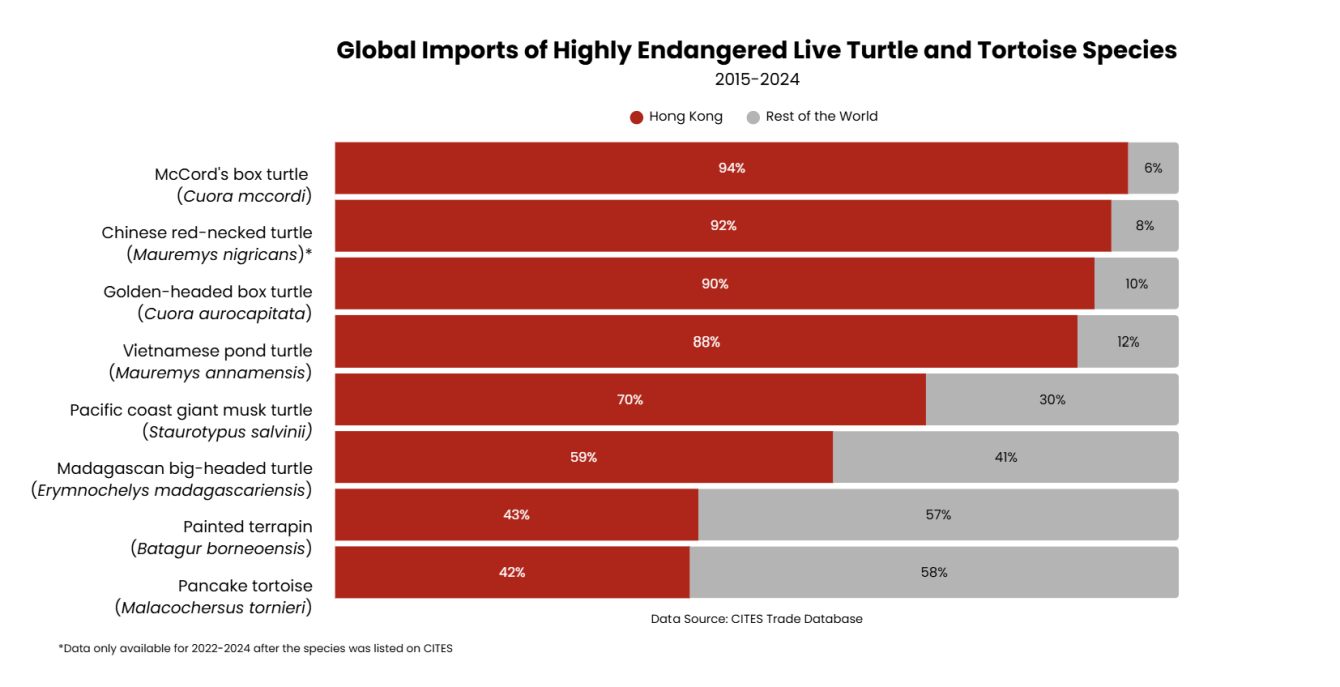
These shelled creatures arrive in Hong Kong in large quantities. The city was the top importer of CITES-regulated turtles and tortoises globally between 2015-2024, with more than 4.3 million live CITES-listed turtles entering the city. This is almost twice as many as the second‑largest importer, mainland China. Comparing Hong Kong’s import volumes with global figures (2015-2024), the city’s dominant role in the trade of endangered turtle and tortoise species becomes apparent – ranking as the world’s leading importer for eight species.
The majority of these imports come from captive‑bred sources overseas, but there are several species that rely on wild populations. Between 2015-2024, for example, half of Hong Kong’s imported Madagascan big-headed turtles were sourced directly from the wild in Madagascar. These very populations have suffered a sharp decline, driven by poaching, plummeting by 85% over the past 75 years. Even with captive breeding, recovery of wild populations of Madagascan big-headed turtles remains difficult due to the species’ slow reproductive rate and habitat loss from urbanisation. As the leading global importer of diverse turtle species including Madagascan big‑headed turtles, Hong Kong sits at the heart of an unsustainable trade that could push these species’ already fragile wild populations closer to extinction.
Illegal At Source
Many tortoises enter Hong Kong as “farmed” animals, but researchers in range states have raised concerns that some of these so-called farms are laundering wild-caught animals. This is well demonstrated by the pancake tortoise. Hong Kong’s official records of the pancake tortoise indicate almost 5,500 “farmed” tortoises were imported from Zambia between 2015-2019. However, there is no evidence of breeding facilities there, and the Zambian government has only been able to establish that a population of around 500 individuals are present in the country. Scientists believe that during this period most of the pancake tortoises in trade were harvested wild from Tanzania then laundered through Zambia.
Over this period Hong Kong accounted for nearly half of all pancake tortoise imports worldwide. Wild populations are small and slow‑reproducing (adults only reach sexual maturity at 5-9 years and laying just one or two eggs per year), while the added pressure from international trade has driven sharp declines, leaving the species at extremely high risk of extinction in the wild. Reflecting this crisis, the species’ conservation status on the IUCN Red List was raised from Vulnerable to Critically Endangered in 2018, and it was moved from CITES Appendix II to Appendix I in 2019, effectively banning all international commercial trade.
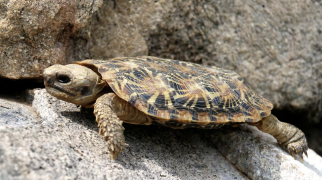
The pancake tortoise has been afforded some protection with the elevation of its conservation status, but this has only come after years of heavy trade pressure and threats from global heating and land use change. It is possibly too late to spare the species from eradication.
For other less-protected turtle species, the situation remains precarious, since the boundary between legal and illegal trade is often opaque. Without greater traceability, accountability and oversight, legal channels risk being exploited as a cover by wildlife criminals, undermining conservation efforts and accelerating the decline of already endangered species.
Local Seizures, Global Crimes
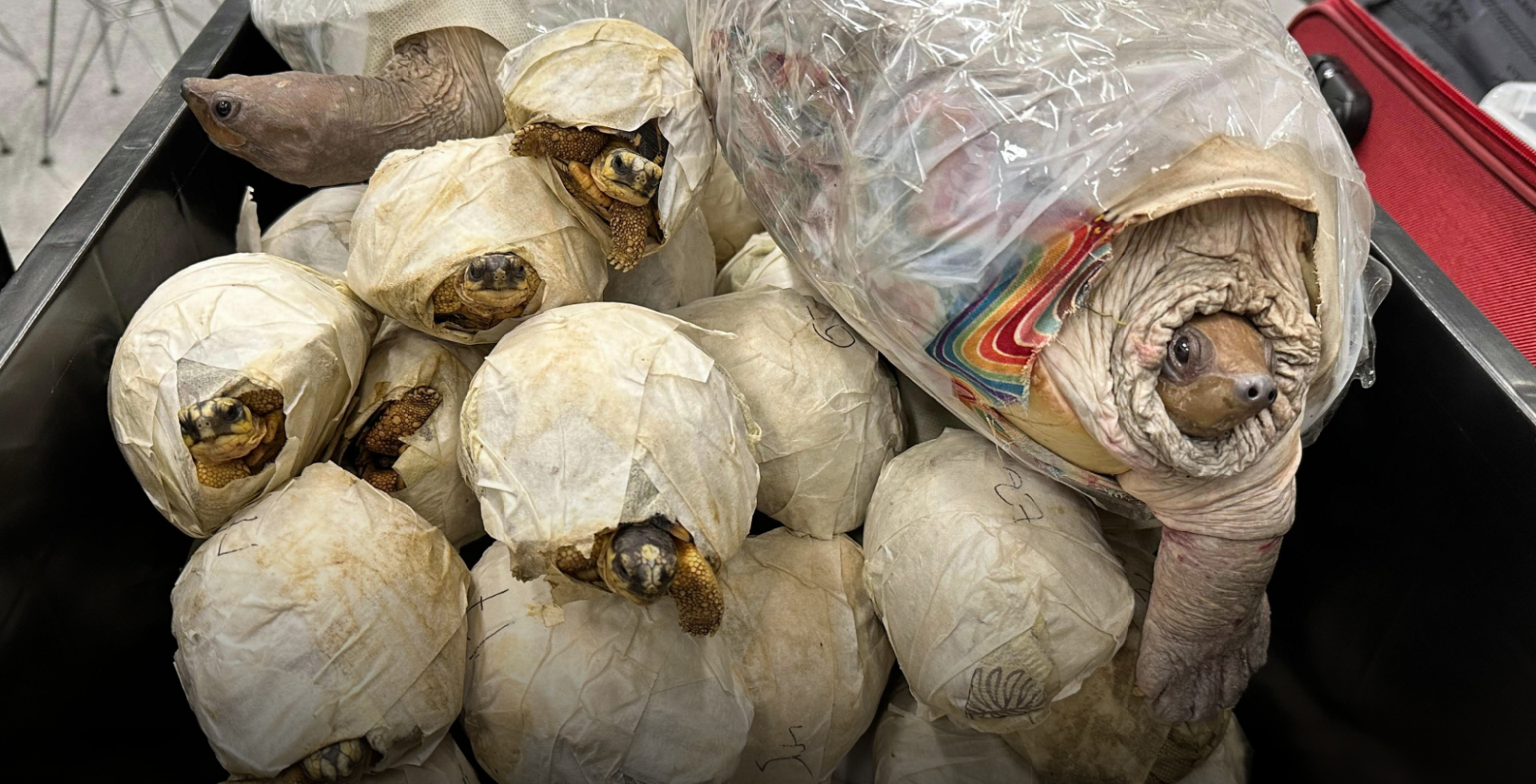
Hong Kong also serves as a significant hub for the illegal trafficking of endangered turtles and tortoises. According to ADM Capital Foundation’s Wildlife Product Seizures (WiPS) database, local authorities have confiscated more than 50,800 live turtles and tortoises from at least 68 species since 2015. Most were intercepted while being smuggled outbound to mainland China by sea or road, though seizures are now increasingly common on inbound routes from mainland China and USA, hidden in passengers’ luggage or sent via airmail.
At least 12 of the species that have been seized in Hong Kong are among the highly endangered turtles identified by the Turtle Conservation Coalition. The most frequently seized species by number of incidents are the Chinese three‑striped box turtles (e.g., in 2022, 2023) and the radiated tortoise (e.g., in 2024), likely driven by demand in the pet market.
Even small-scale trafficking incidents can be highly consequential, such as the 2025 case of the six Vallarta mud turtles, which was mentioned at the beginning of this article. The Critically Endangered species are micro-endemic – only found in a very restricted geographic area of wetlands in Mexico – and were only formally described in 2018. As the species is protected under Mexican conservation laws and listed in CITES Appendix I, there is no legal pathway for commercial possession abroad. We can deduce that their appearance on a Hong Kong retailer’s social media account was likely illegal.
Repatriated But Scarred
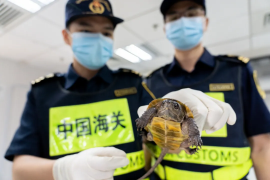
According to ADMCF’s Database, since 2015, at least seven species that were profiled by the Turtle Conservation Coalition have been seized overseas in incidents connected to Hong Kong. These overseas seizures include cases where turtles were exported from Hong Kong but intercepted only after reaching international borders, or stopped abroad before they could be imported into the city.
One of the recent seizures in mainland China involved 58 Asian big-headed turtles (Platysternon megacephalum) confiscated by Chinese customs in 2024. The species is one of five freshwater turtle species native to Hong Kong, mostly found in streams in New Territories. On a global scale, the population of Asian big-headed turtles has declined by over 90% in the past 90 years. In Hong Kong, a study by Lingnan University found that there are fewer than a thousand Asian big-headed turtle adults left in the wild.
In 2025, the 58 Asian big-headed turtles were repatriated to Hong Kong and sent to release and breeding programmes. However, many turtles were in bad shape with fractured tails and fingers. Despite the successful repatriation, the welfare damage, the costs of long-term care, the ecological harm, and other consequences of this crime are incalculable.
Consumer Considerations
Hong Kong authorities have made important progress in safeguarding sustainable wildlife trade through successful seizures of illegal wildlife. More still needs to be done to ensure that traders’ and consumers’ responsibilities are clear and consistently followed, giving buyers confidence that the turtles behind the glass can be traced to legitimate supply chains.
Beyond enforcement, consumers also have a role to play. They should think carefully before acquiring turtles as pets, including whether a species is suitable for their level of experience and whether they understand the long-term care required.
Many threatened turtles have a long lifespan and some are sourced from the wild. They may require specialised enrichment and potentially expensive, complex veterinary care. Demand for rare species also fuels poaching and trafficking, pushing vulnerable populations closer to extinction. Understanding the supply chain and the impacts of trade helps prevent criminals from profiting at the expense of biodiversity.

Latest Updates


