
Hong Kong Dried Seafood Street: Where Culture and Conservation Collide
“Hoi Mei Gaai” is the familiar Cantonese name that we use to refer to Hong Kong’s “Dried Seafood Street” in Sheung Wan. Literally meaning “Taste of the Sea Street,” Hoi Mei Gaai is a culturally significant centre of trade in dried gourmet foods that are highly prized in Chinese cuisine including controversial products such as sharks fin and other endangered marine wildlife.
The actual “street” refers to a series of interconnected roads, together forming a network of vendors that dates back to the 19th century. Walking around the neighbourhood, you can see age-old shops filled from floor to ceiling with large dusty glass jars containing beige, brown, and black shapes meticulously sorted by size. These are usually dried shark fin, dried sea cucumber, or dried abalone. Looking upwards, you may see the swim bladders of fish, i.e. dried fish maw, dangling from the ceiling, secured with pieces of string and a price scrawled on a paper tag. Some shops may also prominently display gigantic shark fins or the rostra of sawfish, decorated with red ornaments.
Dried Seafood Street is intrinsically linked to the health of our oceans. As a global hub for the dried seafood trade, Hong Kong plays a significant role in the circulation of products such as shark fins, including those from endangered species. Over the decades, the presence of certain products in the market has shifted, reflecting not only changing consumer preferences but also the decline of some species in the wild.
We spoke with Kathleen Ho from BLOOM, a marine conservation NGO in Hong Kong that has conducted extensive research at Dried Seafood Street. This long-term work provides critical insight into the market and serves as a key step toward understanding how global trade impacts endangered marine species.
Trade Diversity at Dried Seafood Street
Question: What products can we normally find at the Dried Seafood Street?
Kathleen: One of the first things that strikes visitors at the Dried Seafood Street is the sheer volume of marine life that is jam-packed into the hundreds of stores that are found there. It puts the immense scale of the trade into perspective.
The most common items found are the “Big Four” of local cuisine: shark fin, sea cucumber, abalone and fish maw. But there is a great diversity of other dried marine products available, including conch, scallops, squid, seaweed, and dried fish. Others may seem more unusual, such as starfish, seahorses and sea moths.
A wide variety of products derived from non-marine wildlife can also be found, such as geckos, crocodile parts, snake skins, mushrooms, deer tail, and bird’s nest. Some of these are commonly used for Traditional Chinese Medicine. There is also the much sought-after “zombie” caterpillar fungus, a type of fungus that has infected and consumed a specific type of caterpillar and has taken its shape. Faat choi is also popular, a type of cyanobacteria traditionally eaten during Lunar New Year because of the phonetic similarity of its name to the Cantonese term meaning “prosperity.”
Implications on Biodiversity and Conservation
Question: Can you tell us about the impact of the Dried Seafood Street on biodiversity conservation?
Kathleen: The abundance of products at the traditional shops belies the urgency of the biodiversity crises stemming from unsustainable trade in marine species.
BLOOM and its partners have been conducting research at the Sheung Wan Dried Seafood Street for more than a decade and parts of this research is supported by ADMCF. The on-the-ground work helped to create a comprehensive picture of Hong Kong’s shark fin trade and consumption, enabling the successful inclusion of threatened sharks and rays into the Convention on International Trade in Endangered Species of Wild Fauna and Flora (CITES). CITES is the global treaty that regulates the international trade of threatened wildlife.
At the end of 2025, more than 70 species of sharks and rays were added to CITES. These new species listings, combined with past listings, mean that more than 95% of Hong Kong’s shark fin trade is now under international trade regulation. Products derived from whale sharks and oceanic whitetip sharks are furthermore fully banned from international trade.
Hong Kong is a major trading hub for many CITES-regulated marine species. The city remains the largest legal importer of certain CITES‑listed shark species, accounting for over 67% of reported global imports in 2015–2021.
The recent inclusion of Holothuriidae sea cucumbers to CITES Appendix II will also have ramifications for Hong Kong. According to CITES trade data, three places made up 80% of all golden sandfish (H. lessoni) sea cucumber imports between 2015-2024. Hong Kong is the second largest importer, accounting for 23% of the trade.
While much of the city’s imports are re-exported to other destinations, some also remain in the local market for consumption. They can be found in shops and supermarkets scattered all over Hong Kong, but the densest concentration of vendors is around Sheung Wan’s Dried Seafood Street.
Researching the Shark Fin Trade
Question: What are you looking for at the market?
Kathleen: We focused on the dried shark fin trade and tried to determine the species composition of the trade.
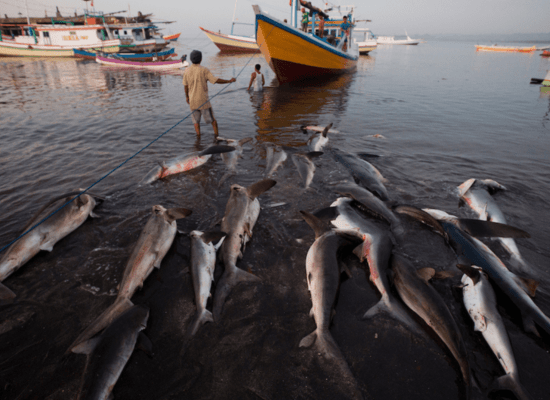
The shark fin trade is one of the major drivers of shark exploitation in fisheries all over the world, most of which are not managed on a species-specific basis. If nobody understands what species are being traded, it would be difficult to talk about the protection of the actual species.
We started in 2014, and we randomly selected and genetically identified fin trimmings from the Dried Seafood Street. We found at least 76 species of sharks, batoids, and chimaeras supplied the fin trade and that one-third of identified species are threatened with extinction.
Our study served as a baseline to track changes in composition of species in the fin trade over time to better understand patterns of exploitation and assess the effects of emerging management actions for these animals.
Challenges in Conservation Research
Question: What are the main hurdles you face while conducting research at Hoi Mei Gaai?
Kathleen: The main challenge of the research is the lack of money to buy the whole fins, as they are very expensive, and to maintain continuous sampling. Plus the fact that nobody had undertaken studies since 2006, so there was a huge gap in the data before our projects started around 2014.
Another issue is that many marine products look alike after they are processed and dried. While each product at Hoi Mei Gaai has a label, the names are not always meaningful for understanding the species involved.
Vendors use Chinese retail categories to sort their products for business purposes. Shark fins are sold by trade category names such as the Gold Mountain Shark Fin, which is a generic category said to refer to fins that came from, or are related to, the United States.
Other categories include the more exclusive Five Oceans Shark Fin (“Wu Yang Chi”), the Spring Shark Fin (“Chun Chi”), the “Wu Gu” (勿骨 ) fins, and many others. A study in 2006 revealed that the above mentioned categories actually corresponded to specific species or groups of species. However, there are also generically labelled bags of mixed fins that look largely uniform. These mixed bags, and the Gold Mountain Shark Fin, form the majority of the market, and species information was impossible to extract from just the product labels.
Lack of proper species identification by the vendors makes it challenging for researchers to monitor changes in the market. The study of the trade of sea cucumber and fish maw has the same challenges and an ongoing study conducted by BLOOM and ADMCF is attempting to correlate trade category names with species or places of origin.
Historical Evolution of Hoi Mei Gaai
Question: How has Dried Seafood Street changed over the years?
Kathleen: Hoi Mei Gaai evolved organically in Hong Kong’s Western District over more than 150 years. Today, the shops are most densely concentrated around Des Voeux Road West, thinning out and ending roughly at Western Street towards the west, and Wing Wo Street towards the east. More than 300 stores operate daily.
Many of these streets were added to the cityscape during land reclamation projects in the mid-1800s, which included the establishment of a trading dock on Connaught Road West that brought imported goods into the area. Thanks to connections with overseas Chinese settlers who took up the trade of dried seafood, a vibrant market was soon established in Sheung Wan.
By the 1970s, Hong Kong’s economy was surging and industry boomed. The expansion of fisheries met with increasing consumer affluence. Dried seafood products became more available and more affordable. Luxury items like shark fin were no longer exclusive to the super rich and cheaper categories of fish maw made it into lower income households.
Today, the market has become a bonafide landmark for shoppers and tourists. It is often crowded in the lead up to special festivals when certain gourmet ingredients are needed for traditional dishes.
Future Direction for Research and Conservation

Question: What’s next for you?
Kathleen: Although a large proportion of the shark fin trade is now regulated, our work at the dried seafood market does not stop here.
In the coming years, BLOOM and ADMCF will be supporting work to examine the fish maw trade, the next giant of the dried seafood market. Hong Kong imports fish maw from over 110 countries/ territories with an average annual import of US$280 million per year and fish maw is one of the “Big Four” at the Dried Seafood Market, as I mentioned.
BLOOM will also continue to monitor changes in the availability of shark fin products in Hoi Mei Gaai following the latest CITES trade regulation updates.
The cultural significance of the consumption practices also comes into focus. While we may think about dried seafood consumers as older individuals from the last generation and perhaps set in their ways, some products, such as fish maw, remain popular among the younger population.
As we work to protect marine species, we are also working to protect a deeply-rooted culture that depends on the sustainability of the marine species that it uses. Marine conservation through trade regulation will keep the dried seafood trade – and the associated Chinese cultural traditions – alive.

Latest Updates